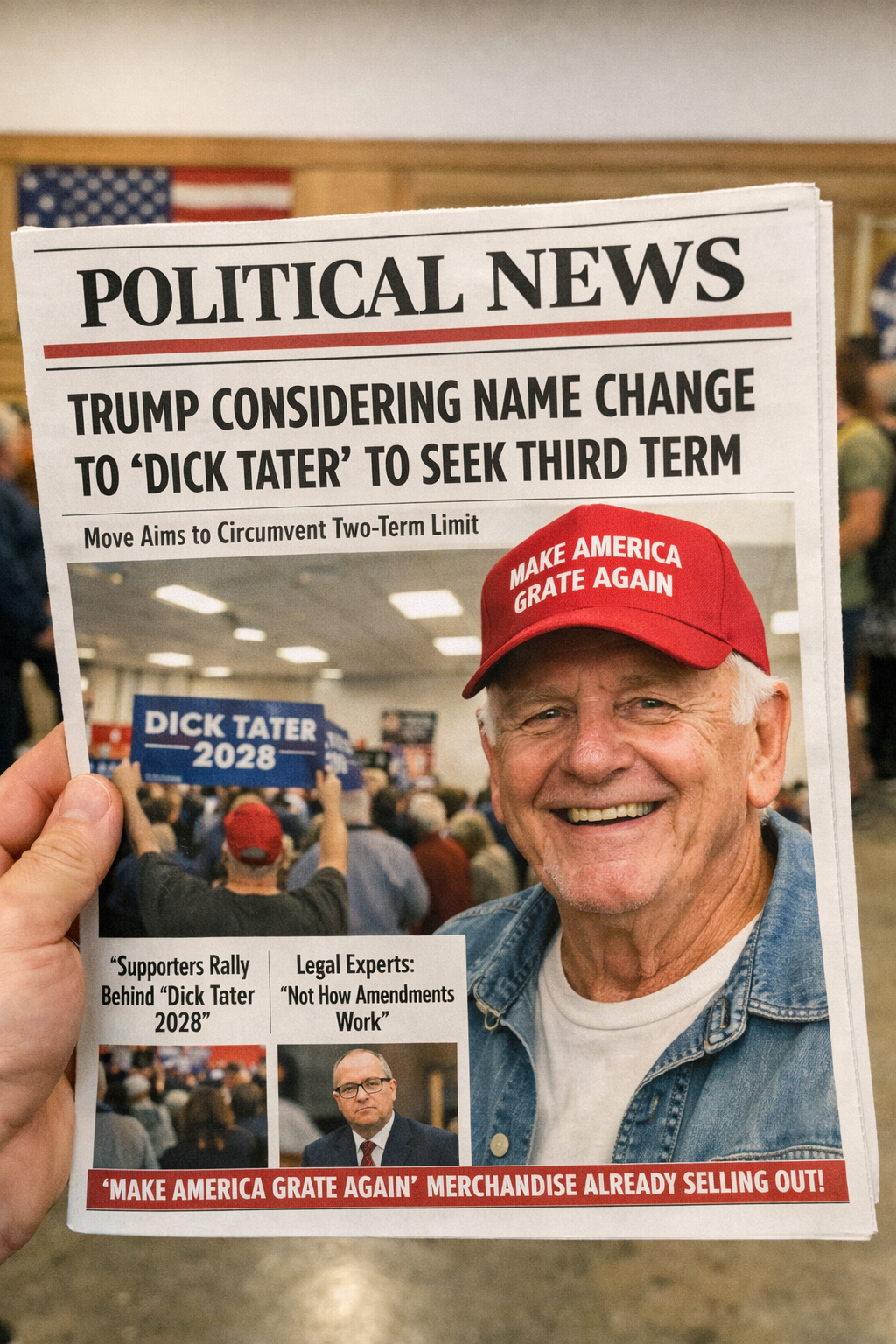
Trump Reportedly Exploring Legal Path to Third Term by Simply Becoming "Dick Tater"
By Clive Bannister, Senior Constitutional Correspondent
WASHINGTON — In what aides are describing as "a bold but technically vegetable-forward interpretation of constitutional law," President Donald Trump is reportedly considering legally changing his name to "Dick Tater" in order to pursue a third term in office.
According to individuals familiar with late-night strategy sessions at Mar-a-Lago, attorneys close to the president have been studying the 22nd Amendment with unusual intensity. The amendment, ratified in 1951, limits a person to being elected president twice. What it does not explicitly reference, aides have noted, is agricultural reclassification.
"The Constitution is a living document," said one adviser who requested anonymity in order to continue reading it selectively. "It applies to Donald J. Trump. It does not apply to Dick Tater. Those are separate legal identities."
Legal scholars were less persuaded.
"You cannot evade term limits by altering your name," said Professor Martin Kellerman, a constitutional law expert at Georgetown University. "If that were possible, we would have seen President Franklin Delano Roosevelt return as 'Frankie Del Root.'"
Still, campaign insiders insist the strategy is being explored "seriously but patriotically." Documents circulating among senior advisers outline a multi-phase rebranding effort tentatively titled the "Tater State Strategy," which would emphasize agricultural symbolism and "strong roots in American soil."
Draft messaging reportedly includes the slogan "Strong Roots. Stronger Rule." Early mock-ups of campaign materials feature rustic typography and imagery of a resolute potato silhouetted against a sunrise over rolling farmland.
At a recent rally in Idaho, the president alluded to the possibility without confirming it outright.
"They say I can't run again," he told the crowd. "Two terms, they say. But they never said anything about vegetables. And I love farmers. The best farmers. Incredible soil."
Supporters in attendance appeared enthusiastic. Many wore red caps reading "Make America Grate Again," while others waved placards declaring "Spuds for Freedom."
"I think it's brilliant," said local attendee Randy Miller. "Corporations rebrand all the time. Why can't presidents?"
Constitutional experts maintain that the amendment refers to the individual, not the name under which that individual files paperwork. But insiders argue the rebrand is less about literal legal loopholes and more about "creative narrative reframing."
"This is about growth," said one strategist. "America needs leaders who can thrive in difficult conditions."
The proposal has sparked debate among political observers about the nature of democratic guardrails. Term limits were designed to prevent the consolidation of executive power, particularly in response to Roosevelt's four-term presidency. Any attempt to test their boundaries — literal or rhetorical — inevitably raises broader questions about institutional stability.
"This isn't about potatoes," said Kellerman. "It's about whether the norms and structures that sustain democracy are treated as serious constraints or as branding opportunities."
Campaign spokespeople declined to comment directly on whether official name-change paperwork has been filed. However, a recently registered domain, DickTater2028.com, suggests preparations may already be underway.
At press time, legal analysts confirmed that while the Constitution does not classify presidents as root vegetables, it also does not explicitly forbid it — a detail campaign aides reportedly described as "promising."
Whether the idea is a serious strategy or a symbolic gesture remains unclear. What is certain is that the conversation has forced constitutional scholars to confront questions they never expected to ask, including whether a candidate listed as Solanum tuberosum would qualify for ballot access in all 50 states.
For now, the president remains Donald J. Trump. But in a political era defined by unprecedented maneuvers, even the possibility of executive office being pursued under a horticultural alias has prompted renewed discussion about the resilience of America's democratic soil.